![[personal profile]](https://www.dreamwidth.org/img/silk/identity/user.png) shadowkat
shadowkatMy female writer meme which I attempted with mixed results, has inspired me to try something new in this journal. We'll see if I can keep it up. Once or twice a week, I will attempt to post an essay on female writers and directors - celebrating and highlighting their work, with links to their work and to their history.
Since February is Black History Month in the US, I'm starting with Black Women Writers and Directors. I will most likely concentrate on the one's whose work I am familiar with.
The following three women writers have many things in common besides gender and race. The main one is each has found a way to show the world that we need to learn to see beyond race and gender, that neither define us absolutely. They are a part of who we are, but not a defining factor. And we need to learn to see past them. Women can be firemen and surgeons. They can be gods. Black or white or purple. And should not be placed in cages. But these women find a way to show not tell this. They do not speak from soap boxes or bully pulpits or blogs, but instead through the poetry of stories, visual and written. Pulling the reader or viewer inside their minds, so we can see through their eyes.
Shondra Rhimes
Shondra Rhimes is known primarily for the creation of Grey's Anatomy - a ground-breaking American medical drama that focused on the lives of female and male surgeons, but has a female centric point of view. It is also amongst the few dramas to feature an interracial cast and a lesbian relationship at its center.
Rhimes is amongst the few black female television show-runners with a hit show that has been in the Neilsen top ten for more than 7 years. And has been nominated for multiple Emmy's including several during the series initial run.
Her film and television resume includes:
* Scandal - a 2012 tv series
* Private Practice -2007-2012
* Grey's Anatomy -2005-2012
* a corizon alberto - tv series 2010
* The Princess Diaries 2 - film
* Crossroads - 2002 film
* Introducing Dorothy Dandridge - teleplay - tv movie
* Blossums and Viels
While she's won various awards and has had her fair share of controversy (notably the Isiah Washington scandal back in the early seasons of the series - the less said about this the better, both actors are long gone from the television landscape), Rhimes has broken television barriers.
A fan of Buffy the Vampire Slayer and the Sopranoes, her work has been undeniably influenced by both - and she pushes for character centric tales.
Rhimes greatest gift is creating complex ethnically diverse characters. Chandra Wilson's fiery Baily, a petite, heavy-set, black female surgeon who has evolved into one of the most intriguing characters on primetime tv, Sandra Oh's Korean-American Cristina - the brilliant surgeon, the Chief - a black male head of the hospital, Callie Thores - a bi-sexual heavy-set Latino woman who has a child and gets married to a lesbian. Rhimes characters do not look the same. They aren't stick thin, with pretty hair and in their 20s. And white. She pushed the envelope. And continues to do so. While Grey's is at times way too melodramatic for my taste and crazy, it can hit a few balls out of the park. Rhimes is a writer to watch.
2. Octavia Butler
Octavia Estelle Butler (June 22, 1947 – February 24, 2006) was an American science fiction writer, one of the best-known among the few African-American women in the field. Amongst her works is possibly the best time travel sci-fi novel I've read Kindred or at the very least the most memorable. It is about a woman in the present pulled back into the distant past - due to her connection to a slave-owner.
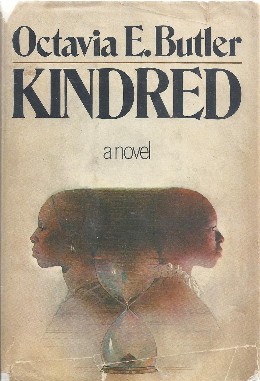
I read Kindred back in 2003 and can't forget it. It stays with you long after you've finished. Each word indelibly imprinted on your consciousness. What's interesting about it - is it discusses an interracial relationship in the 1970s, and in slave times. As well as the wounds of slavery, and how we can never quite get past them. Dana's husband is thrown back with her, and works on the underground rail-road. You see slavery from three points of view. A book that I highly recommend everyone read.
Butler's sci-fi novels include:
The Patternist series - Wild Seed is the first book in this series of novels.
Butler's novels much like Maria Doria Russell's The Sparrow, explored biological and anthropological issues in science fiction as opposed to technological. As well as religious themes. These books were begun in the 1970s and 1980s.
Here's a list of her works via wiki:
And here's a snippet from an article by Octavia Butler - in O Magazine:
http://www.oprah.com/spirit/Octavia-Butlers-Aha-Moment - written in 2002.
Read more: http://www.oprah.com/spirit/Octavia-Butlers-Aha-Moment/2#ixzz1msP08g8X
3. Maya Angelo
Maya Angelo is a jack of all trades, a chanteuse, a writer, a director, and a poet. She's also an activist. I have regrettably not read much of Maya Angelo.
From Wiki:
Maya Angelou (play /ˈmaɪ.ə ˈændʒəloʊ/;[1][2] born Marguerite Ann Johnson; April 4, 1928) is an American author and poet who has been called "America's most visible black female autobiographer" by scholar Joanne M. Braxton. She is best known for her series of six autobiographical volumes, which focus on her childhood and early adult experiences. The first and most highly acclaimed, I Know Why the Caged Bird Sings (1969), tells of her first seventeen years. It brought her international recognition, and was nominated for a National Book Award.
I would add that she is in some respects best known for her poetry. See below.
http://www.poemhunter.com/poem/i-know-why-the-caged-bird-sings/
Maya Angelo is also a director - she directed the film Down in the Delta which was the first film directed by a black woman director.
For more information on Maya and her works - go here:
http://mayaangelou.com/news/
Since February is Black History Month in the US, I'm starting with Black Women Writers and Directors. I will most likely concentrate on the one's whose work I am familiar with.
The following three women writers have many things in common besides gender and race. The main one is each has found a way to show the world that we need to learn to see beyond race and gender, that neither define us absolutely. They are a part of who we are, but not a defining factor. And we need to learn to see past them. Women can be firemen and surgeons. They can be gods. Black or white or purple. And should not be placed in cages. But these women find a way to show not tell this. They do not speak from soap boxes or bully pulpits or blogs, but instead through the poetry of stories, visual and written. Pulling the reader or viewer inside their minds, so we can see through their eyes.
Shondra Rhimes
Shondra Rhimes is known primarily for the creation of Grey's Anatomy - a ground-breaking American medical drama that focused on the lives of female and male surgeons, but has a female centric point of view. It is also amongst the few dramas to feature an interracial cast and a lesbian relationship at its center.
Rhimes is amongst the few black female television show-runners with a hit show that has been in the Neilsen top ten for more than 7 years. And has been nominated for multiple Emmy's including several during the series initial run.
Her film and television resume includes:
* Scandal - a 2012 tv series
* Private Practice -2007-2012
* Grey's Anatomy -2005-2012
* a corizon alberto - tv series 2010
* The Princess Diaries 2 - film
* Crossroads - 2002 film
* Introducing Dorothy Dandridge - teleplay - tv movie
* Blossums and Viels
While she's won various awards and has had her fair share of controversy (notably the Isiah Washington scandal back in the early seasons of the series - the less said about this the better, both actors are long gone from the television landscape), Rhimes has broken television barriers.
A fan of Buffy the Vampire Slayer and the Sopranoes, her work has been undeniably influenced by both - and she pushes for character centric tales.
Rhimes greatest gift is creating complex ethnically diverse characters. Chandra Wilson's fiery Baily, a petite, heavy-set, black female surgeon who has evolved into one of the most intriguing characters on primetime tv, Sandra Oh's Korean-American Cristina - the brilliant surgeon, the Chief - a black male head of the hospital, Callie Thores - a bi-sexual heavy-set Latino woman who has a child and gets married to a lesbian. Rhimes characters do not look the same. They aren't stick thin, with pretty hair and in their 20s. And white. She pushed the envelope. And continues to do so. While Grey's is at times way too melodramatic for my taste and crazy, it can hit a few balls out of the park. Rhimes is a writer to watch.
2. Octavia Butler
Octavia Estelle Butler (June 22, 1947 – February 24, 2006) was an American science fiction writer, one of the best-known among the few African-American women in the field. Amongst her works is possibly the best time travel sci-fi novel I've read Kindred or at the very least the most memorable. It is about a woman in the present pulled back into the distant past - due to her connection to a slave-owner.
Kindred tells the story of Edana (Dana) Franklin, an African American woman living in 1976 Pasadena, CA who, on her twenty-sixth birthday, begins the first of six involuntary journeys back in time to Maryland's Eastern Shore in the antebellum South. She soon finds out that she has been unconsciously summoned (through means that are never fully explained) by Rufus Weylin, a young white boy who is the son of a slave owner, Tom Weylin, and her distant ancestor. Rufus calls for Dana whenever he feels his life is in danger, from the time he is a child through to adulthood, forcing Dana to rescue him from the perceived immediate threat. But the cost is dear: Dana must also guarantee her own future survival by learning to exist on the plantation as a slave, taking steps to ensure that one of her black ancestors on the plantation, Alice, herself the daughter of a free woman, eventually has a child with Rufus that will become Dana's direct ancestor.
I read Kindred back in 2003 and can't forget it. It stays with you long after you've finished. Each word indelibly imprinted on your consciousness. What's interesting about it - is it discusses an interracial relationship in the 1970s, and in slave times. As well as the wounds of slavery, and how we can never quite get past them. Dana's husband is thrown back with her, and works on the underground rail-road. You see slavery from three points of view. A book that I highly recommend everyone read.
Butler's sci-fi novels include:
The Patternist series - Wild Seed is the first book in this series of novels.
Wild Seed, the first book in the Patternist series, was published in 1980. In Wild Seed, Butler contrasts how two potentially immortal characters go about building families. The male character, Doro, engages in a breeding program to create people with stronger psychic powers both as food, and as potential companions. The female character, Anyanwu, creates villages. Yet Doro and Anyanwu, in spite of their differences grow to need each other, as the only immortal/extremely long-lived beings in the world. This book also explores the psychodynamics of power and enslavement.
Butler's novels much like Maria Doria Russell's The Sparrow, explored biological and anthropological issues in science fiction as opposed to technological. As well as religious themes. These books were begun in the 1970s and 1980s.
Here's a list of her works via wiki:
* Patternist series
o Patternmaster (1976)
o Mind of My Mind (1977)
o Survivor (1978)
o Wild Seed (1980)
o Clay's Ark (1984)
o Seed to Harvest (compilation; 2007-does not include Survivor)
* Lilith's Brood (formerly the Xenogenesis trilogy)
o Dawn (1987)
o Adulthood Rites (1988)
o Imago (1989)
* Parable Series
o Parable of the Sower (1993)
o Parable of the Talents (1998)
Standalone novels
* Kindred (1979)
* Fledgling (2005)
Short stories
* Bloodchild and Other Stories (1995); Second edition with additional stories (2006)
And here's a snippet from an article by Octavia Butler - in O Magazine:
http://www.oprah.com/spirit/Octavia-Butlers-Aha-Moment - written in 2002.
.........Eyes scared me or drew my interest. Eyes reminded me that someone else was there. When I was 7 and went to the zoo with my second-grade class, I saw chimpanzee eyes for the first time—the eyes of an unhappy animal, all alone, locked in a bare, concrete-floored, iron-barred cage in one of the nastier, old-fashioned zoos. I remember looking at the chimp, then looking away. The chimp had somehow become the target of some of the kids' attention. They shouted at him, laughed, and threw peanuts—threw them at him rather than to him. The chimp had nowhere to hide and, lucky for the kids, nothing to throw back. He leaped about and screamed, and the kids thought it was really funny. I looked at the animal's eyes—frantic, furious and maybe not sane anymore—and if I could have left the zoo at that moment, I would have. I was still too young to understand the concept of being ashamed of my species. I just felt horrible. I wanted the other kids to shut up. I wanted the chimp to be free.
At age 7, I learned to hate solid, physical cages—cages with real bars like the ones that made the chimp's world tiny, vulnerable and barren. Later I learned to hate the metaphorical cages that people try to use to avoid getting to know one another—cages of race, gender or class.
I've known since I was barely 3, sitting on the stairs with Baba, that it is better—much more interesting—to get to know others and to discover who and what they are. It is better to look into their eyes with open curiosity and learn once more about someone else.
Read more: http://www.oprah.com/spirit/Octavia-Butlers-Aha-Moment/2#ixzz1msP08g8X
3. Maya Angelo
Maya Angelo is a jack of all trades, a chanteuse, a writer, a director, and a poet. She's also an activist. I have regrettably not read much of Maya Angelo.
From Wiki:
Maya Angelou (play /ˈmaɪ.ə ˈændʒəloʊ/;[1][2] born Marguerite Ann Johnson; April 4, 1928) is an American author and poet who has been called "America's most visible black female autobiographer" by scholar Joanne M. Braxton. She is best known for her series of six autobiographical volumes, which focus on her childhood and early adult experiences. The first and most highly acclaimed, I Know Why the Caged Bird Sings (1969), tells of her first seventeen years. It brought her international recognition, and was nominated for a National Book Award.
I would add that she is in some respects best known for her poetry. See below.
I Know Why The Caged Bird Sings
The free bird leaps
on the back of the win
and floats downstream
till the current ends
and dips his wings
in the orange sun rays
and dares to claim the sky.
But a bird that stalks
down his narrow cage
can seldom see through
his bars of rage
his wings are clipped and
his feet are tied
so he opens his throat to sing.
The caged bird sings
with fearful trill
of the things unknown
but longed for still
and is tune is heard
on the distant hillfor the caged bird
sings of freedom
The free bird thinks of another breeze
an the trade winds soft through the sighing trees
and the fat worms waiting on a dawn-bright lawn
and he names the sky his own.
But a caged bird stands on the grave of dreams
his shadow shouts on a nightmare scream
his wings are clipped and his feet are tied
so he opens his throat to sing
The caged bird sings
with a fearful trill
of things unknown
but longed for still
and his tune is heard
on the distant hill
for the caged bird
sings of freedom.
Maya Angelou
http://www.poemhunter.com/poem/i-know-why-the-caged-bird-sings/
Maya Angelo is also a director - she directed the film Down in the Delta which was the first film directed by a black woman director.
Her screenplay,Georgia, Georgia (1972), was the first original script by a Black woman to be produced and she was the first African American woman to direct a major motion picture, Down in the Delta, in 1998.
For more information on Maya and her works - go here:
http://mayaangelou.com/news/
![[identity profile]](https://www.dreamwidth.org/img/silk/identity/openid.png)
no subject
Date: 2012-02-20 03:43 am (UTC)no subject
Date: 2012-02-20 03:44 am (UTC)no subject
Date: 2012-02-20 02:29 pm (UTC)